ENTANGLED THREADS
Part of the opt:exp Research Framework
Entangled Threads is an ongoing artistic research framework exploring relationships between bodies, materials and technological systems. Through textile, sound, light, interaction and sensory experimentation, the work investigates how knowledge and experience move between material and computational worlds.
The framework develops through distinct artistic studies, each approaching these relationships from a different perspective. Rather than following a single research question, the projects form an evolving field of inquiry in which cultural practices, scientific phenomena and technological systems meet.
Investigates
Invisible relationships between bodies, materials, signals, and environments
Translation between physical phenomena, data, and sensory experience
Textile as a medium for connection, sensing, and transformation
Embodied interaction and material knowledge
Relationships between sound, light, movement, and computational processes


The Golden Signal
The Golden Signal explores the meeting of textile traditions and computational systems through interactive textile experiments informed by zlatovez, a traditional gold-thread embroidery practice from Eastern Croatia. The embroidery carries cultural and personal significance, connecting material practice with inherited knowledge, memory and the gestures of making.
By bringing this tradition into contact with conductive materials, sensors and computational responses, the project investigates how textile can become an interactive medium. Gesture, touch and material properties become part of a system in which physical actions can trigger or shape sound, light and other responses. The work asks what happens when knowledge carried through the hands encounters computational logic, and how a culturally situated material practice might change through this interaction.
The project is ongoing, with further experiments exploring the relationships between embodied knowledge, textile, interaction and technological mediation.

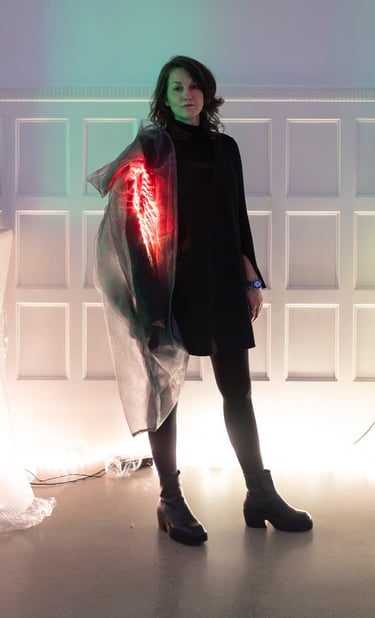
c photo: Fabian Thueroff
// Research Directions:
c photo: artist archive
Textile, Science and the Body
This direction investigates how scientific phenomena and structures can be translated into sensory, material and embodied experiences. Through textile, sound, light and spatial experimentation, it explores how processes that are difficult to perceive can become tangible, and how artistic translation can open alternative ways of engaging with scientific knowledge.
Folding Field is a completed artwork that provides a starting point for further research into artistic translation as a method of inquiry. Future work will continue to explore the relationships between scientific systems, material processes and bodily perception.